
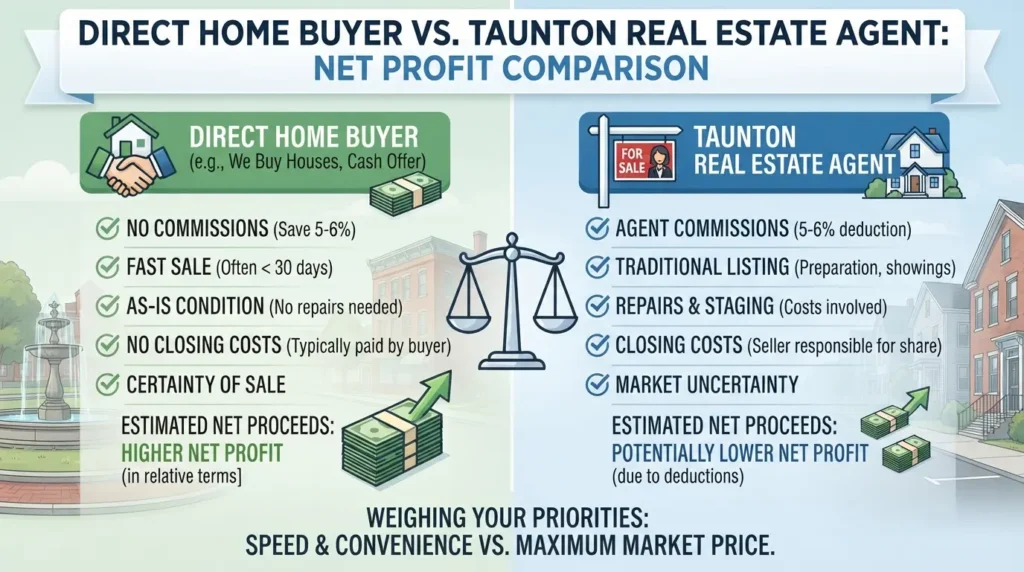
When it is time to sell your home in Massachusetts, the traditional route of hiring a Taunton real estate agent is often the automatic choice. Most homeowners assume that hitting the Multiple Listing Service (MLS) is the only definitive path to maximizing their return. However, a growing number of property owners are looking at alternative methods, specifically comparing a direct home buyer against a traditional listing.
By analyzing Eastside Home Solutions, a direct home buying company operating in Bristol County, sellers are beginning to see how a direct transaction compares side-by-side with a retail agent. This analysis focuses on the cold, hard numbers of a pure transaction, breaking down the actual financial variables that dictate your walk-away cash. By transparently evaluating the math behind both options, you can accurately decide whether the speed and convenience of an off-market sale ultimately beat the potential top-dollar allure of the open market.
To truly understand how much money lands in your bank account at the closing table, you have to look past the initial sticker price. The headline sales price is rarely the amount of money you actually keep. Selling a home involves an entire ecosystem of frictional costs, holding expenses, operational fees, and transactional outlays. For the vast majority of sellers, the core question is simple: which method yields the highest net profit? To answer this, we must examine the hidden mechanics of real estate commissions, mandatory repair demands, buyer concessions, ongoing carrying costs, and the administrative fees that chip away at your equity.
The True Cost of Listing with a Traditional Agent

Listing your property with a licensed professional means entering the retail real estate market. The primary objective of this method is to expose the home to the largest possible audience of retail buyers, theoretically driving up the purchase price through competition. However, this exposure comes at a steep financial premium that directly impacts your final net profit.
Commission Structures and Broken Equity
The most significant and predictable expense when working with a traditional brokerage is the real estate commission. In standard transactions, this fee generally ranges between 5% and 6% of the gross sales price, which is typically split between the listing agent and the buyer’s agent.
While 6% might sound manageable on paper, it represents a massive portion of your actual home equity. For instance, if you sell a home in Bristol County for $400,000, a 6% commission instantly deducts $24,000 from your proceeds. If you owe $300,000 on your mortgage, your actual equity in the home is $100,000. That $24,000 commission does not consume 6% of your profit; it consumes 24% of your hard-earned net equity. This friction cost is entirely unavoidable on the open market, as retail buyers rely heavily on agents to guide them through the purchasing process.
The Retail Repair Mandate and Home Inspection Pitfalls
Retail buyers are looking for properties that are move-in ready. They are typically financing their purchase through conventional loans, FHA loans, or VA loans, all of which enforce strict appraisal guidelines regarding the safety, soundness, and structural integrity of the property. Consequently, selling through an agent almost always requires upfront or negotiated investments in home remediation.
The process usually unfolds in two distinct financial phases:
- Pre-listing Preparation: To compete with other homes on the MLS, an agent will often advise you to paint, replace aging carpets, landscape, update outdated fixtures, or repair minor deferred maintenance issues. These out-of-pocket expenses must be paid before the house ever receives an offer.
- The Inspection Contingency: Once an offer is accepted, the buyer will hire a licensed home inspector. These inspectors generate exhaustive reports detailing every flaw in the foundation, roof, electrical systems, plumbing, and HVAC systems. The buyer will then issue a repair amendment, demanding that you either fix these items before closing or grant a significant financial credit. If you refuse, the buyer can walk away with their earnest money deposit intact, forcing you to relist a now-stigmatized property.
Buyer Concessions and Closing Cost Subsidies
In competitive or stabilizing markets, retail buyers frequently lack the liquid cash required to cover both their down payment and their transactional closing costs. To bridge this gap, buyers often submit offers that include a request for seller concessions.
A seller concession requires the homeowner to pay a percentage of the buyer’s closing costs (such as loan origination fees, title insurance, and escrow setups) out of their final sale proceeds. This can easily subtract another 2% to 3% from your net profit. While the gross sale price remains high on public records, the cash delivered to your bank account drops dollar-for-dollar by the exact amount of the concession granted.
The Mechanics of a Direct Home Sale
A direct home sale completely bypasses the open retail market. Instead of hiring a professional to find a buyer, you sell the property directly to a real estate investment firm or cash buyer. The fundamental value proposition of this method relies on eliminating transactional friction, accelerating timelines, and removing the unpredictability of traditional finance contingencies.
Zero Commissions and Fee Elimination
Because a direct sale does not involve advertising on the MLS or utilizing institutional representation, standard real estate commissions are entirely eliminated. The buyer acts as the principal party in the transaction, removing the middleman completely.
When evaluating how this works in practice, understanding the step-by-step home-buying process of a direct transaction helps clarify how fees are bypassed. The buyer acts as the principal party in the transaction, removing the middleman completely. When a direct buyer makes an offer, that number is generally a true net figure regarding transaction fees. There are no broker fees, no listing percentages, and in many instances, the direct buyer will even cover the standard seller closing costs, such as transfer taxes, escrow fees, and title search charges.
Selling Entirely “As-Is”
One of the defining financial elements of a direct purchase is the absolute adherence to an “as-is” contract clause. A direct home buyer purchases properties utilizing private capital or dedicated lines of credit, meaning they do not answer to the rigid guidelines of institutional mortgage underwriters.
For homeowners with properties that need major structural or cosmetic renovations, utilizing a specialized cash home buyers service is the easiest way to avoid the retail repair mandate. The direct buyer calculates the cost of all necessary repairs—whether it is a failing roof, an outdated electrical panel, structural settling, or water damage—into their initial underwriting model. The seller is not required to lift a finger, spend a dollar of liquid capital, or manage contractors.
Certainty, Velocity, and the Elimination of Financing Contingencies
Traditional real estate transactions are highly fragile due to their reliance on bank financing. A retail buyer might love your home, possess excellent credit, and hold a pre-approval letter, yet their loan can still fall through at the eleventh hour due to sudden underwriting changes, macro-economic shifts, or appraisal shortfalls.
A direct sale relies on verified cash funds. There are no financing contingencies, no formal bank appraisals, and no lengthy loan underwriting periods. This structural certainty eliminates the risk of a collapsed sale, ensuring that the agreed-upon price is exactly what is delivered at closing. Furthermore, the velocity of a cash transaction allows the sale to close in a matter of days rather than months, giving the seller immediate access to their liquid capital.
The Hidden Drain: Holding Costs and Time Value of Money
When analyzing the net profits of a home sale, many property owners fail to account for the ongoing cost of keeping a house on the market. Time is not free. Every day, week, and month that your property sits active, pending, or under contract on the MLS, it is actively draining capital away from your eventual net profit. These are known as carrying or holding costs.
Breaking Down Monthly Carrying Costs
While a home is listed for sale, the owner remains fully responsible for all financial obligations associated with property maintenance. These expenses do not pause during the marketing period. They include:
- Mortgage Interest: Every monthly payment made while waiting for a buyer consists largely of interest, which does not build equity but represents a pure transactional loss.
- Property Taxes: Local municipalities continue to assess taxes daily, which are prorated and deducted directly from your proceeds at closing.
- Homeowners Insurance: Continuous premium payments are required to protect the asset during the listing period.
- Utilities: Electricity, gas, water, and sewer must remain fully operational for broker showings, open houses, and home inspections.
- Maintenance and Upkeep: Regular lawn care, snow removal, gutter cleaning, and general property management must be maintained to avoid losing curb appeal and violating local codes.
If your combined monthly holding costs total $2,500, a traditional listing process that takes four months from the initial clean-up to the final closing date will quietly erase $10,000 from your net return.
The Real Timeline of an MLS Transaction
Homeowners often mistake the timeline of finding a buyer with the timeline of completing a sale. On the retail market, even if your agent secures a qualified buyer within the first 21 days of listing, the transaction is just getting started.
The average time required for an institutional bank to process a standard residential mortgage ranges from 30 to 45 days after the purchase agreement is fully signed. When you add the initial time spent cleaning, upgrading, photographing, marketing, and hosting open houses, the entire timeline frequently spans 60 to 90 days or longer. If you need a guaranteed timeline to relocate or settle local affairs, choosing to sell your house fast in Taunton allows you to bypass this entire cycle and close in as little as 7 days.
Line-by-Line Mathematical Breakdown
To make an informed, analytical decision, you must compare these two methods side-by-side using pure transactional math. Let us look at how the numbers distribute under a hypothetical, yet realistic, scenario for a mid-range residential property.
The Traditional Agent Scenario
Imagine your home has a theoretical market value of $450,000 if it were completely updated and listed on the MLS. You decide to hire a traditional agent to pursue this maximum retail value.
First, to prepare the home for the competitive market, you invest $10,000 out-of-pocket into new flooring, interior paint, and minor landscaping. The home goes live, and after 30 days of showings, you accept a full-price offer of $450,000.
The buyers hire an inspector who discovers that the HVAC system is near the end of its lifespan and the electrical panel needs an upgrade. After intense negotiations, you agree to grant a $7,000 credit at closing to address these issues. Additionally, the buyer’s loan requires an extra 60 days to close, during which you incur three months of carrying costs totaling $7,500.
At the closing table, the transactional fees are systematically applied:
- Gross Sales Price: $450,000
- 6% Broker Commission: -$27,000
- Negotiated Inspection Credits: -$7,000
- Seller-Paid Closing Costs/Escrow Fees: -$3,500
- Upfront Repair Investment: -$10,000
- Accumulated Holding Costs: -$7,500
When you subtract the commissions, the inspection credits, the administrative closing costs, the initial repair investment, and the accrued carrying costs from the gross sales price, your true net profit stands at $395,000. The traditional route successfully secured a high retail sales price, but the operational expenses consumed $55,000 of the home’s total value.
The Direct Buyer Scenario
Now let us analyze the exact same property under a direct sale model. Because the home requires upgrades and repairs, a direct buyer accounts for these deficiencies in their initial valuation. They offer a lower gross purchase price of $405,000, explicitly purchasing the property in its current “as-is” condition.
Because this transaction removes the traditional retail apparatus entirely, the financial deductions look radically different:
- Gross Sales Price: $405,000
- Broker Commission: $0 (No agents are involved)
- Inspection Repairs/Credits: $0 (Purchased completely as-is)
- Closing Costs: $0 (The direct buyer covers all title and escrow fees)
- Upfront Repair Investment: $0 (No preparation or staging required)
- Accumulated Holding Costs: -$625 (The transaction closes smoothly in just one week, eliminating months of carrying costs)
When evaluating this path, your true net profit stands at $404,375.
Analyzing the Spread
When you compare the final net results of both scenarios, an interesting mathematical reality emerges. Even though the traditional listing secured a gross sales price that was $45,000 higher than the direct cash offer, the actual net profit delivered to the seller’s bank account was remarkably similar. In this specific comparison, the direct sale actually netted the homeowner slightly more cash due to the complete elimination of commissions, retail repair outlays, and holding costs.
While every property exhibits unique characteristics, this exercise demonstrates why evaluating a home sale strictly by the gross contract price is a deeply flawed financial strategy.
Strategic Considerations: Quantifying Convenience and Risk

While the pure math should form the bedrock of your decision-making process, a property transaction cannot be conducted completely in a vacuum. There are qualitative risks and operational variables that carry immense financial weight, even if they do not appear as distinct line items on a closing disclosure.
The Risk of Deal Fallout
One of the most significant liabilities of the traditional market is transaction fragility. When you accept an offer on the MLS, your home enters a phase known as “Under One of the most significant liabilities of the traditional market is transaction fragility. If the buyer’s financing falls through at day 45 because of an uncooperative underwriter or an unexpected change in the buyer’s employment status, the deal collapses.
For homeowners facing strict, unyielding deadlines, this fragility can result in critical financial emergencies. If you are trying to sell to pay off debts or find foreclosure solutions before the bank steps in, you cannot afford a retail deal that collapses at the last second.
If a deal fails on the traditional market, you introduce two distinct financial penalties:
- The Stigma Factor: Retail buyers and their agents view relisted properties with immediate skepticism, assuming a major physical defect caused the previous deal to fail. This often results in lower subsequent offers.
- Extended Holding Costs: Your carrying costs instantly double as you begin the marketing, showing, and underwriting cycle all over again from day one.
A direct sale completely eliminates this vulnerability. The transaction relies on liquid, verified funds, meaning the probability of deal completion is near absolute once the contract is executed.
Convenience as a Financial Asset
Convenience is often discussed as a luxury, but in asset management, convenience equates to risk mitigation. Selling a home traditionally requires a significant expenditure of personal time and emotional energy. You must keep the home in pristine condition daily, abandon your property at a moment’s notice for last-minute showings, manage pets during open houses, and deal with the stress of public scrutiny.
For individuals navigating complex life transitions—such as settling an estate, managing a divorce, relocating out of state for employment, avoiding foreclosure, or liquidating a problematic rental property with uncooperative tenants—the traditional retail process can introduce catastrophic delays. In these scenarios, the ability to control the exact date of your departure, leave unwanted belongings behind, and avoid the public eye provides a massive operational advantage that easily offsets a lower gross sales price.
Conclusion: Weighing the Math to Make Your Decision
Ultimately, choosing between listing with an agent or selling to a direct home buyer requires a cold, objective assessment of your property’s current physical condition, your available liquid capital, and your tolerance for market risk. There is no universally correct path; there is only the path that aligns with your financial and timeline goals.
If your property is fully modernized, located in a high-demand neighborhood, and you possess the luxury of time to wait out a traditional mortgage underwriting process, the open market via the MLS remains an incredibly powerful vehicle for capturing peak retail value. The competition generated by an experienced agent can potentially drive the price high enough to absorb the steep commission fees, inspection credits, and carrying costs while still leaving a substantial net return.
However, if your home requires notable capital improvements, has significant deferred maintenance, or if your life circumstances demand a guaranteed, rapid close, the math decisively shifts toward a direct sale. By removing commissions, bypassing home inspection demands, eliminating buyer concessions, and halting the monthly drain of carrying costs, a direct transaction offers a highly predictable, mathematically defensible alternative.
Before making your choice, review your current mortgage balance, obtain realistic quotes for any necessary repairs, calculate your exact monthly holding costs, and carefully analyze the true net proceeds of both paths. Strip away the emotion, focus entirely on the transactional math, and choose the option that delivers the highest net profit to your bank account with a risk profile you can confidently manage.